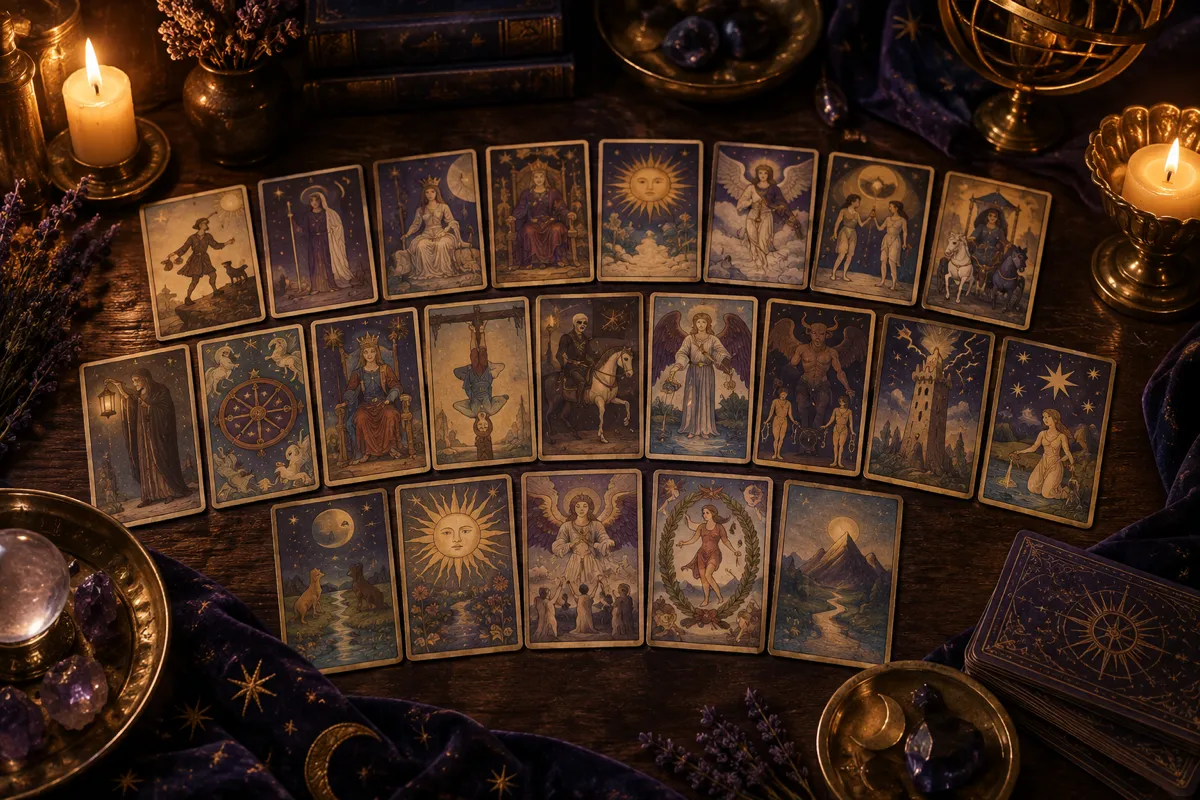
The Major Arcana: All 22 Cards and What They Mean
The Major Arcana are the twenty-two cards most people picture when they picture tarot: The Lovers, The Tower, Death. They are read as the larger movements of a life rather than its daily weather, which is why one turning up in a spread tends to redirect the whole reading.
Traditional meanings follow. Reversals are included, though plenty of readers do not use them and read the whole card from context instead. Both approaches are long-standing.
0 to VII: setting out
- 0 The Fool: beginnings, risk taken without a map. Reversed: recklessness, or refusing to start.
- I The Magician: capability, resources already in hand. Reversed: manipulation, or talent going unused.
- II The High Priestess: what is known but not spoken, intuition over analysis. Reversed: ignoring what you already sense.
- III The Empress: abundance, creation, nurture. Reversed: smothering, or creativity blocked.
- IV The Emperor: structure, authority, boundaries. Reversed: rigidity, or control exerted where it does not belong.
- V The Hierophant: tradition, institutions, learning from what exists. Reversed: conformity that costs you, or useful rule-breaking.
- VI The Lovers: a choice about values, not only romance. Reversed: misalignment, or a decision avoided.
- VII The Chariot: will, direction, momentum held together. Reversed: drift, or force where patience would serve.
VIII to XIV: the middle work
- VIII Strength: endurance and gentleness rather than force. Reversed: self-doubt, or strength turned brittle.
- IX The Hermit: withdrawal for the sake of clarity. Reversed: isolation that has stopped being useful.
- X Wheel of Fortune: cycles, luck, what you do not control. Reversed: resistance to a turn that is happening anyway.
- XI Justice: consequence, balance, the truth of a situation. Reversed: imbalance, or accountability avoided.
- XII The Hanged Man: suspension, a deliberate pause, seeing it differently. Reversed: stalling dressed as patience.
- XIII Death: an ending that clears ground. Almost never literal. Reversed: clinging to what is already over.
- XIV Temperance: moderation, blending, the long middle path. Reversed: excess, or impatience with a slow process.
Death is the most feared card and one of the most constructive. Readers almost universally take it as transformation, and the card people actually dread in practice is The Tower.
XV to XXI: reckoning and completion
- XV The Devil: attachment, compulsion, a bargain you made and forgot. Reversed: a chain loosening, or recognising the cage is open.
- XVI The Tower: sudden collapse of something built on a bad foundation. Reversed: a disaster delayed or narrowly avoided.
- XVII The Star: hope, repair, orientation after the Tower. Reversed: faith lost, or hope used to avoid acting.
- XVIII The Moon: illusion, uncertainty, the dark you must cross without full information. Reversed: confusion lifting, or deception revealed.
- XIX The Sun: clarity, vitality, things seen plainly. Reversed: optimism that has detached from reality.
- XX Judgement: reckoning, a call that requires an answer, integration. Reversed: self-condemnation, or the call ignored.
- XXI The World: completion, a cycle closed well. Reversed: an ending almost reached, something unfinished.
How to read them together
The order is a sequence. The Fool sets out and arrives at The World, passing through structure, reckoning and collapse on the way. Many readers treat a spread heavy with Major Arcana as a sign that the question is larger than the querent framed it.
The position in the spread changes the reading as much as the card does. The Tower in a position about the past is history; in a position about the near future it is a warning; in a position about the self it is usually about something you are already dismantling.
A note on reversals
Reversed meanings are not simple opposites. The most common readings treat a reversal as the energy blocked, turned inward, or expressed to excess, which is why The Devil reversed can read as liberation while The Sun reversed reads as too much of a good thing.
Many experienced readers do not use reversals at all, taking the full range from the surrounding cards instead. Neither approach is more correct; what matters is being consistent within a reading.
Common questions
- Does the Death card mean someone will die?
- Essentially never in practice. Readers across traditions take it as an ending that makes room: a chapter, a role, a version of yourself.
- What is the difference between the Major and Minor Arcana?
- The 22 Major cards are read as the large movements of a life. The 56 Minor cards, in four suits, cover its daily texture. A spread dominated by Majors is usually read as a question bigger than it was asked.
- Do I have to use reversals?
- No, and many professional readers do not. Consistency within a reading matters more than which convention you pick.
- Can I read tarot for myself?
- Yes, and it is a good way to learn. The known difficulty is that you will unconsciously steer the reading, which is why people keep a written record and look back at it later.
An article is written for everyone
A reading is written for you. Our advisors are available around the clock.